You became the operating system of your solo business. Now what?
A CONVERSATION WITH ALEXIS FERNANDEZ ON WHY AI MAKES MOST SOLO BUSINESSES CHAOTIC INSTEAD OF CALMER, AND THE ONE THING TO BUILD FIRST

One of the things I keep noticing among solopreneurs, including myself, is how quickly we become the entire operating system of our business.
Every decision runs through us, every process lives in our head, every problem eventually lands on our desk. Then AI shows up promising to solve all of it.
Except for many of us, it just creates another layer(s) of complexity.
That's why I wanted to speak with Alexis Fernandez. Alexis spent years as COO of Expath, helping scale the company from five people to sixty-five employees. Today Alexis helps operations leaders simplify processes, integrate AI, and build systems that don't depend on heroic effort to function.
What I liked about this conversation is that Alexis doesn't approach AI as a futurist but as an operator.
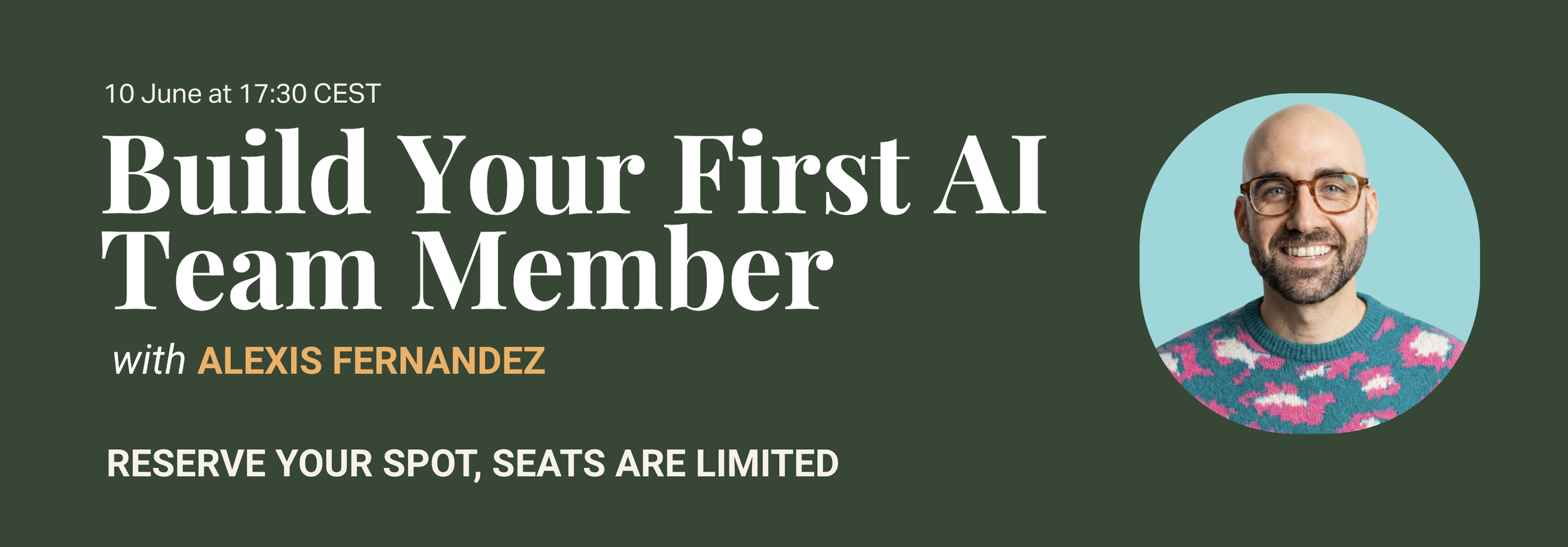
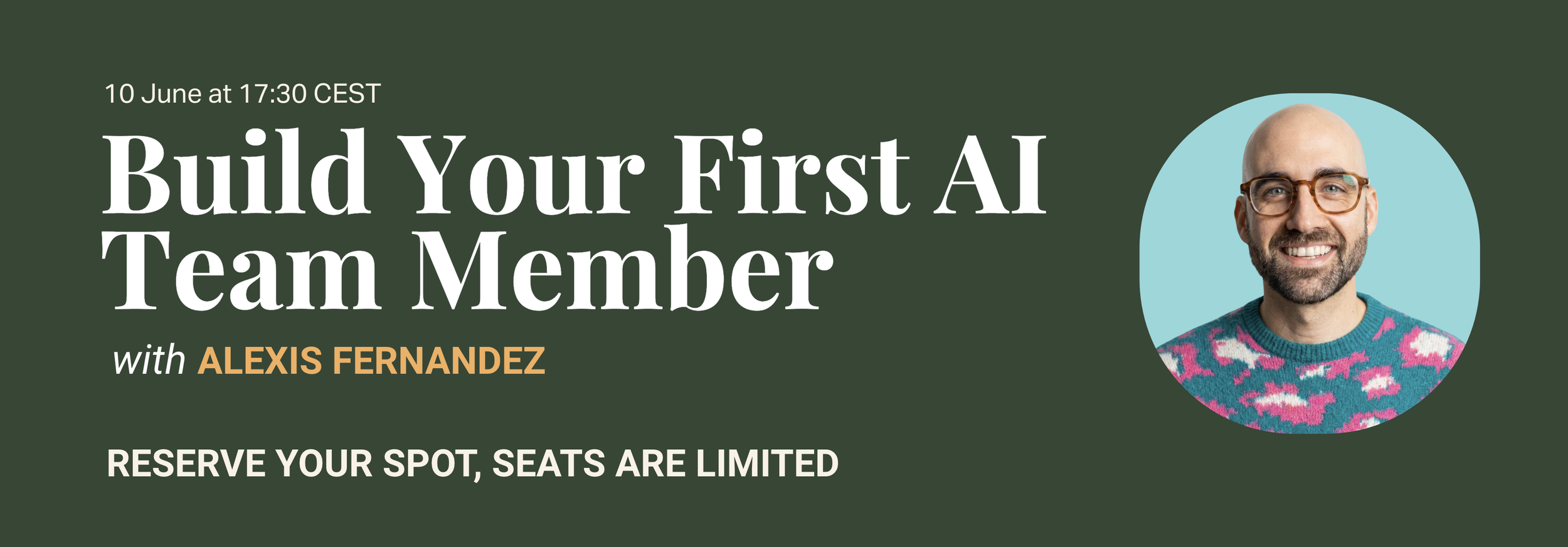
Alexis is someone who spent years figuring out what actually makes work simpler and what just creates more noise. He is also running the “Build your first AI team member” workshop, on the 10th of June at the Solo Accelerator. Get your ticket soon, spots are limited.
Enjoy the interview.
A lot of solopreneurs feel like they became the entire operating system of their business. Why does that happen so easily?
The system rewards you for becoming it. Something breaks; you fix it because you're the only one who can. You fix it once, you get better at fixing it. The better you get, the more the business depends on you doing it.
I lived this. At Expath, I was the COO scaling a company from five people to sixty-five. There was no CFO, no CTO. Just me and the CEO building the infrastructure to keep things from falling apart. By the time growth slowed and I looked up, the company couldn't function without me running every system. The whole time, I'd thought I was being competent.
The solo version is more concentrated. Every system in your business runs through one person — decisions, client relationships, operational threads, all of it. There's nobody else to absorb anything, no second read on a call, no one to notice when you've quietly become the bottleneck.
What gets underestimated is the emotional layer. Becoming the operating system is a kind of identity. Your competence is visible. People rely on you. Stepping back means giving that up, even when it's killing you. That's why "just hire someone" rarely lands with solopreneurs. The obstacle is identity. You've quietly made a deal with yourself about what you're worth when the work runs through you. Letting go of the work means letting go of that deal.
Many people start using AI hoping it will save time, but often they just create more complexity. Why does that happen?
Because AI doesn't have an inherent reason to produce less. You ask for a one-pager and you get a 30-page report. You ask for a research starting point and hundreds of sources come back. Our pre-AI muscle was "find more information." That muscle keeps running, now with a firehose attached. There's a name for the result — "brain fry." Read so much processed information your brain glosses over.
That's only one source of the complexity. The bigger one is what we do upstream of the AI. We bolt it onto processes that didn't work to begin with. The process was tangled before AI; now you have a tangled process running faster. AI doesn't have your institutional knowledge or your workarounds. It doesn't know that "send it to Sarah" actually means "send to Sarah, cc Ignacio if it's over €5K, check the spreadsheet first." Bolted onto chaos, it produces faster, more confident chaos.
There's a related move: systematizing work we haven't done long enough to know the shape of. I catch myself doing this constantly — I'll finish a task once, decide it could be a skill, start building. Most of the time the skill takes longer to build than the task. I'm adding complexity in the name of removing it.
And there's a third layer that doesn't get talked about: AI's output multiplication is networked. The 20-page doc that lands in your inbox. The meeting note nobody asked for. Everyone in your orbit is now sending you more AI-generated material to process. The hidden cost of "AI saved me time" is "AI cost everyone in my orbit time."
What's the difference between using AI as real leverage versus simply adding another layer of noise?
AI is good leverage when it's plugging into a workflow that knows what to do with the output. AI is noise when it's producing things that have no clear next step.
The same prompt can produce either outcome. The difference is whether the system around it was designed to absorb what AI produces.
The litmus test: after AI does the thing, am I closer to done or further from done? If I'm further from done — because now I have to read, verify, format, edit, or send something I wouldn't have created on my own — that's noise dressed as productivity.
You describe AI more as a "team member" than a tool. What changes when solopreneurs approach it that way?
What changes is the relationship becomes durable. When you treat AI as a team member, you build it on purpose. You give it a persona — head of growth, chief of staff, head of services, whatever shape the work needs. Scope: what it owns, what it consults, what it refuses. Context: the docs that matter to its role, the patterns it holds, the voice it uses. You're scaffolding a colleague, with continuity.
I run four of them in my own business. Stella runs growth. Rafa runs services. Ally is chief of staff and holds the operating picture. Kaveh handles the technical side. Each one knows its lane. When I have a sales question, I go to Stella. She has the CRM context, the pipeline view, the voice for that work. I'm not re-explaining who my ICP is every time I open a chat.
For solos this matters more than it does for ops leaders inside companies. Solos can't have a real team. AI team members are specialized, durable thinking partners that hold a piece of your operating reality so you don't have to carry it in your head.
If a solopreneur could only build ONE AI system inside their business, what should they build first?
A morning briefing.
If you could only build one thing, build the skill that pulls the day's signal across all the systems you'd otherwise be checking one by one. Your calendar, your inbox, your CRM, the project management tool you actually use. The skill scans everything and gives you a short, structured read: here's what's on today, what's stale, what's overdue, what you might be missing.
It's the right "one thing" because it puts AI into your daily flow instead of leaving it as something you remember to use when you're working on a specific project. You can build it in an afternoon in Claude or ChatGPT by connecting your tools as integrations.
What kinds of workflows or responsibilities are genuinely great candidates for AI today?
The frame I've started using is "anything where the work is well-understood" — even if you've only done it once or twice, as long as you did it well.
The example I keep coming back to is my work with Babbel. Thirty or forty hours of operational discovery, the custom assistants we built, the cross-workstream synthesis. A lot of that work was bespoke to them. But the shape of the work — what an operational discovery actually looks like, how to structure the synthesis, what the deliverable should be — is now well-defined in my own head. So I can point Claude at that work and build a skill from it. The next operational discovery I run starts with structure already in place.
The cleanest version in my own week is quarterly tax accounting. I built a skill that takes my bank statement exports and whatever invoices I have, produces a to-do list of invoices I still need to find, and outputs the monthly CSVs my tax advisor wants — formatted exactly the way she wants them. The task becomes finding invoices. The skill pulls the info from them and checks them against the bank statement. What used to be a week of dread is now maybe two hours every three months — and two non-painless hours, the kind you can do with a good DJ mix playing.
What both examples have in common is that the work is well-understood. The skill captures how I already do the work and frees me up to focus on the parts that actually require me.
What do you think solopreneurs still need to personally own, even in an AI-heavy business?
What stays yours is everything that genuinely needs your judgment — and the relationships those judgment calls happen inside.
Here's the thing I teach teams about judgment: not every piece of AI output needs the same level of review. A brainstorm bullet list is different from a client deliverable. The skill is developing taste about when to apply care, and being honest with whoever's reading about how much you applied. I use three levels: I didn't really look. I skimmed. I read it with care, I stand behind it. The label tells your reader how much to trust it.
The relationships are the half that AI can't get near. The trust between you and your clients. The texture of how you hold space when something's hard. The reason someone refers you to a friend. AI can help you prep for a call. It can't be you in the call.
These two are bound together. The judgment you bring to a client deliverable is what makes them trust you next time. The trust you've built is what gives them patience when you make a hard call. AI handles the work around the work — the prep, the synthesis, the first drafts, the operational scaffolding. The work itself, the part where you're actually present with another human, is still yours.
We're seeing more solopreneurs building AI-based products and services. What unique challenges come with building a solo business around AI specifically?
The unique challenge is that you're running two different AI architectures at once, often without realizing it.
There's the AI you build for your own business — your team members, your skills, your workflows, your operating picture. That setup serves your business model, your voice, your judgment, your work style. It's built for one operator.
And then there's the AI you build for your clients. Their voice, their workflows, their operating reality, their team structure. The same shapes might apply — context-wrapped team members, well-defined skills, narrow automations — but the content and constraints are different. What works for a solo doesn't necessarily work for a 50-person company.
If your clients happen to be solos building AI businesses too, the two pictures converge and you can mostly reuse your own playbook. But the moment your clients are different — bigger companies, different industries, regulated environments — you're doing two distinct kinds of architecture work in parallel.
That's the unique solo challenge: architecting two kinds of businesses at once, and making sure your own setup doesn't quietly drift to look like what your clients need, or the other way around.
A lot of AI products feel easy to replicate quickly. What creates defensibility now for solo founders?
Defensibility for solo founders has always come from things that compound over time and resist replication: track record, taste, distribution, voice, the people who'll vouch for you. That same principle still holds. AI just makes the contrast sharper.
Anyone can wire up the same models. What's hard to replicate is the wrapper — the way you've decided what problems to take on, who you serve, how you frame those problems, what good output actually looks like in your domain. The wrapper is where defensibility lives.
Concrete example: the Alem AI team I'm building. Four AI team members — growth, services, operations, builds — each with their own context, voice, operating model, and handoff protocols. The model layer underneath all of them is generic. The architecture surrounding the models — what each one knows, what each one refuses, how they hand off to each other — is the part that took a year of taste decisions to build. That part is hard to copy because it's specific to how I work and who I serve.
For a solo founder, that's the moat in AI: the architecture, the taste, the judgment, the relationships. The model is the cheap part now.
If someone listening wants to build a calmer, more sustainable solo business with AI, what mindset shift needs to happen first?
The shift starts with catching the instinct that built the trap in the first place. That instinct is "more will make it right" — more effort, more output, more tools. AI just gives it more horsepower. The same instinct that drove you to overwork pre-AI now has you building skills you don't need post-AI.
The mindset shift is recognizing the real engine of a calmer business. It's refusal. Refusal to do work that doesn't need to be done. Refusal to outsource your own thinking just because AI makes it easy to. That second one matters more than people think. There's an MIT study I keep coming back to: 83% memory failure when people started a task with AI, versus 11% when they thought independently first, then brought AI in. The difference is sequence. Five minutes of your own thinking before you open the chat changes what AI is doing for you. I catch myself wanting the shortcut too. We all do.
A calmer setup runs in this order: get honest about what to stop doing, simplify what's left, and bring AI into the narrow places where it actually helps.
The shift is from more to less. Less, on purpose. AI just makes it easier to act on.